A haptic rhythm for Garmin Watches
A heartbeat-like vibrotactile rhythm on your wrist.
Haptic Pulse reads your optical heart rate and uses the watch’s vibration motor to create a heartbeat-like sensation at 80% of that rate.
● Connect IQ Store release coming soon
Why would you want this?
When a quiet rhythm may be useful.
Haptic pulse provides a quiet physical cue that you can try in situations where a steady rhythm feels welcome.
Before a demanding moment
Some people may prefer a quiet background rhythm while preparing for a presentation, exam or important meeting. Anticipation of public speaking was one setting used in the research that inspired haptic pulse (se below).
During focused work
A tactile cue can provide a steady pace without audio or repeated screen checks. Smartwatch research has explored this kind of feedback during time-pressured mental tasks.
As part of winding down
You might include the rhythm in your own rest, breathing, meditation or bedtime routine, choosing whatever feels comfortable to you.
Curiosity
You may want to feel a heartbeat-like rhythm on your wrist and notice how that experience feels to you.
A haptic cue will not suit everyone. Some people may find a quiet physical rhythm pleasant or useful as a point of focus; others may find repeated vibration distracting, or prefer sound, visual guidance or no cue at all. There is no right response, and if you try it, choose the setting and situation that feels comfortable to you.
Research-inspired design
Where the idea came from.
Perceived heart signals: Gray et al. (2007) found that false auditory heart-rate feedback could change how people judged emotional intensity. This helped establish the broader idea that a cue interpreted as a bodily signal can shape appraisal, even if it is external.
EmotionCheck: Costa et al. (2016) tested a 60 /min heartbeat-like vibration with 67 participants. Anxiety was lower when participants were told the slow vibration represented their heart rate. (The same vibration without that explanation did not differ significantly from the control, suggesting that interpretation may matter).
Later wearables tested slower pacing. Azevedo et al. (2017) used a double heartbeat-like wrist vibration about 20% below resting heart rate. Costa et al. (2019) tested slower and faster Apple Watch feedback during pressured math tasks. Both studies reported differences in selected anxiety, physiological or performance measures in their specific laboratory settings.
The response is not uniform. Xu et al. (2021) found that physiological responses varied with interoceptive accuracy. Dobrushina et al. (2024) found that real-time haptic heartbeat feedback could improve heartbeat discrimination and shift attention toward bodily sensations compared with visual feedback. (But that study used synchronized chest stimulation rather than a slower wrist rhythm).
What this means for Haptic Pulse
The idea has a genuine research history, and the 80% default reflects the 20%-below-baseline rate used by Azevedo and colleagues. The studies above tested other devices, signals in a laboratory setting. Haptic Pulse itself has not been scientifically evaluated. Therefore, their results cannot be transferred to this app, and no effect on stress, anxiety, heart rate or performance can be claimed. Haptic Pulse is offered as a personal haptic pacing tool.
Selected references
Gray, M. A., Harrison, N. A., Wiens, S., & Critchley, H. D. (2007). Modulation of emotional appraisal by false physiological feedback during fMRI. PLOS ONE, 2(6), Article e546. https://doi.org/10.1371/journal.pone.0000546
Costa, J., Adams, A. T., Jung, M. F., Guimbretière, F., & Choudhury, T. (2016). EmotionCheck: Leveraging bodily signals and false feedback to regulate our emotions. Proceedings of the 2016 ACM International Joint Conference on Pervasive and Ubiquitous Computing, 758–769. https://doi.org/10.1145/2971648.2971752
Azevedo, R. T., Bennett, N., Bilicki, A., Hooper, J., Markopoulou, F., & Tsakiris, M. (2017). The calming effect of a new wearable device during the anticipation of public speech. Scientific Reports, 7, Article 2285. https://doi.org/10.1038/s41598-017-02274-2
Costa, J., Guimbretière, F., Jung, M. F., & Choudhury, T. (2019). BoostMeUp: Improving cognitive performance in the moment by unobtrusively regulating emotions with a smartwatch. Proceedings of the ACM on Interactive, Mobile, Wearable and Ubiquitous Technologies, 3(2), Article 40. https://doi.org/10.1145/3328911
Xu, M., Tachibana, T., Suzuki, N., Hoshino, E., Terasawa, Y., Miki, N., & Minagawa, Y. (2021). The effect of haptic stimulation simulating heartbeats on the regulation of physiological responses and prosocial behavior under stress: The influence of interoceptive accuracy. Biological Psychology, 164, Article 108172. https://doi.org/10.1016/j.biopsycho.2021.108172
Dobrushina, O., Tamim, Y., Wald, I. Y., Maimon, A., & Amedi, A. (2024). Interoceptive training with real-time haptic versus visual heartbeat feedback. Psychophysiology, 61(11), Article e14648. https://doi.org/10.1111/psyp.14648
What the app does
It turns your measured heart rate into a slower, heartbeat-like vibrotactile stimulation.
Haptic pulse follows your watches optical heart-rate reading and translates it into a slower haptic pulse. (The default setting is 80% of your measured HR).
01
Reads your heart rate
In Adaptive mode, the watch uses its optical sensor during the session and smooths the recent heart-rate readings.
02
Calculates a slower rate
The default haptic rate is 80% of the measured heart rate, (within a range of 40–100 /min). For example, a measured 75 bpm becomes 60 haptic pulses per minute.
03
Repeats a heartbeat-like pulse
The vibration motor creates a repeating heartbeat-like sensation at that rate and adjusts gradually as the heart-rate reading changes.
Optional manual rate · 4 heartbeat-like patterns to choose from · Timer 1–10 min or off (Default is 2 minutes).
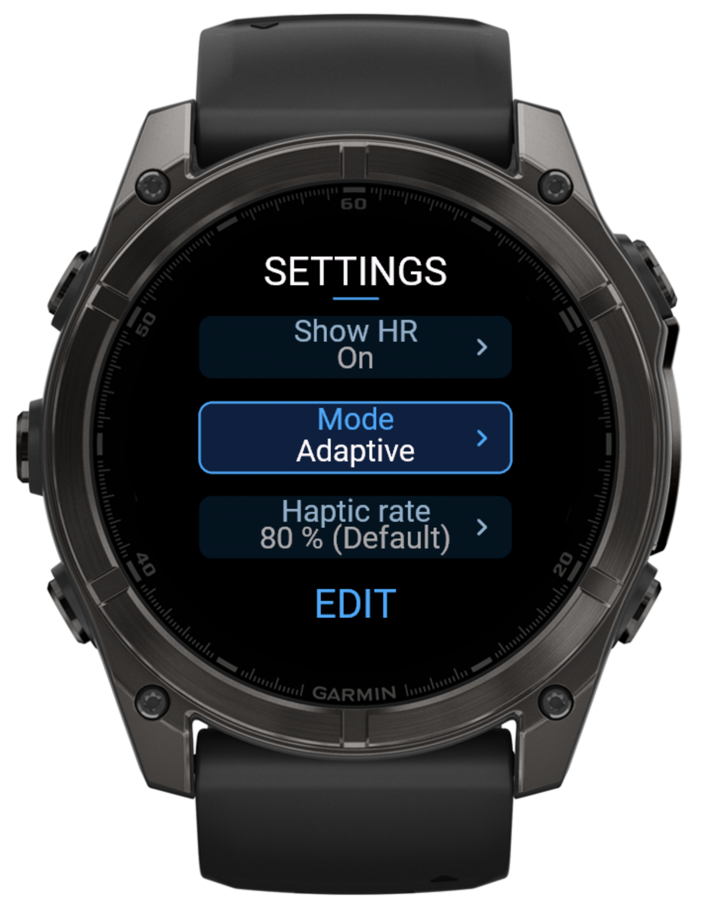
Adaptive by default
80% follows your measured heart rate. (You can also select 70%, 75%, 85% or 90%).
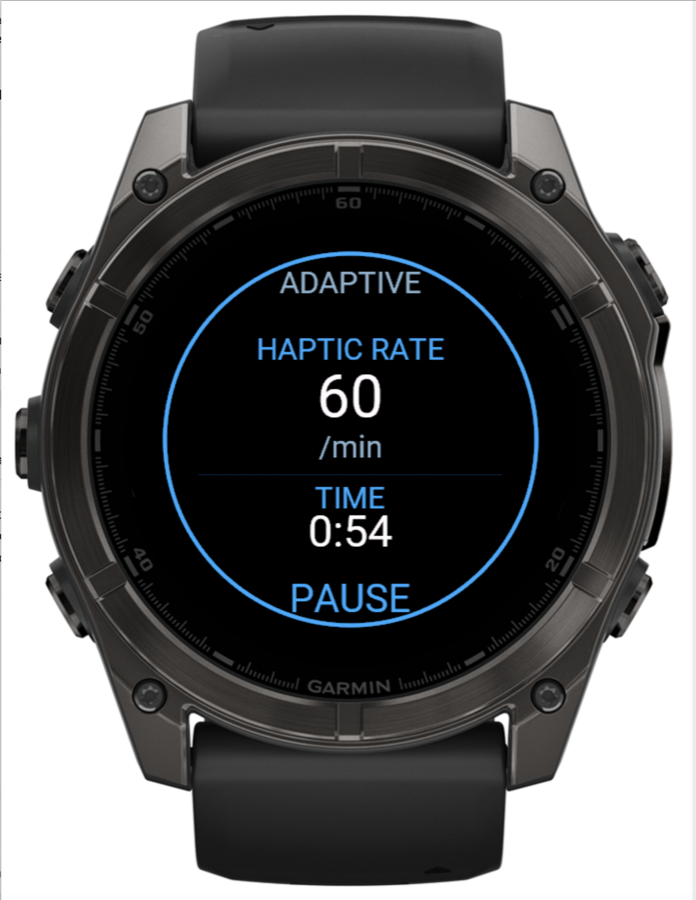
Adjusts during the session
The haptic rate changes gradually as the optical heart-rate reading changes.
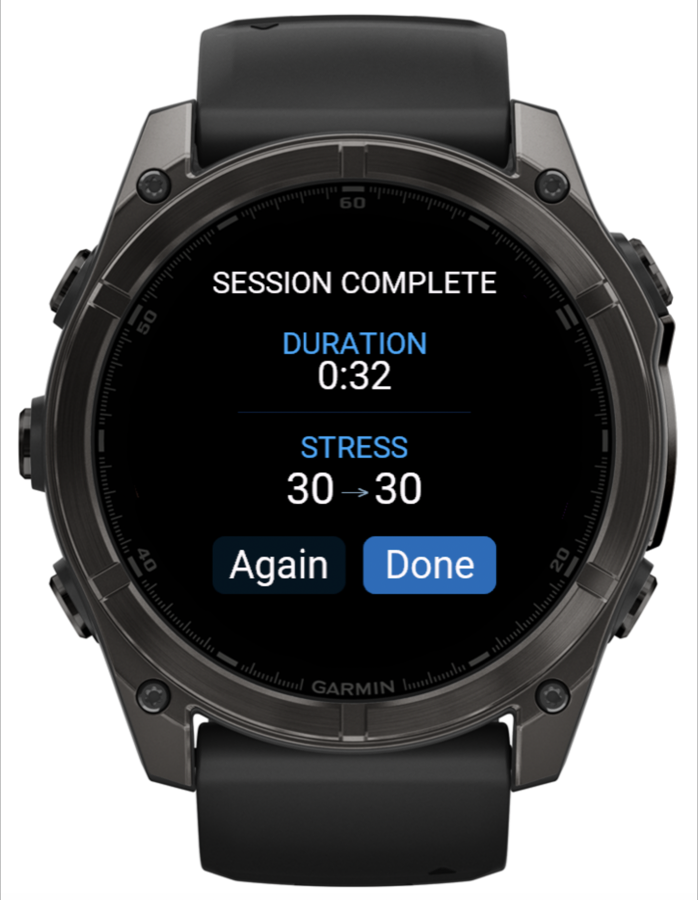
Ends with a simple summary
The end of session summary displays HR and Garmin stress scores at start and finish (if your watch supports them)
Privacy policy
No data is collected or stored remotely
Effective 23 August 2026
What the app uses
Live heart rate is used for Adaptive mode (and can optionally be displayed during sessions). The app may also show Garmin’s stress scores and stores your settings on the watch.
Data collection
There is no account, advertising, analytics, tracking or network access. No personal, health or usage data is sent to the developer.
Storage and control
Heart-rate and stress information is processed on the watch during use. Settings remain on your watch until you reset them or uninstall the app. No remote user record is created.
Garmin and policy updates
Your watch and Connect IQ are covered by Garmin’s terms and privacy practices. Material changes to this policy will be posted here with a new effective date.
Safety information
Use it as a personal pacing aid.
!
Safety:
Haptic Pulse is a wellness app, not a medical device. It cannot diagnose, monitor or treat a condition. Optical heart-rate and stress readings can be delayed, incomplete or inaccurate and should not guide medical decisions.
Stop if the vibration causes discomfort or distraction. Do not interact with the app while driving or in other situations that require your attention. Speak with a qualified healthcare professional about health concerns.
Support
Support, feedback or suggestions:
For questions, troubleshooting or feedback, contact the developer and include your watch model and app version.